The 1980s wrestling boom
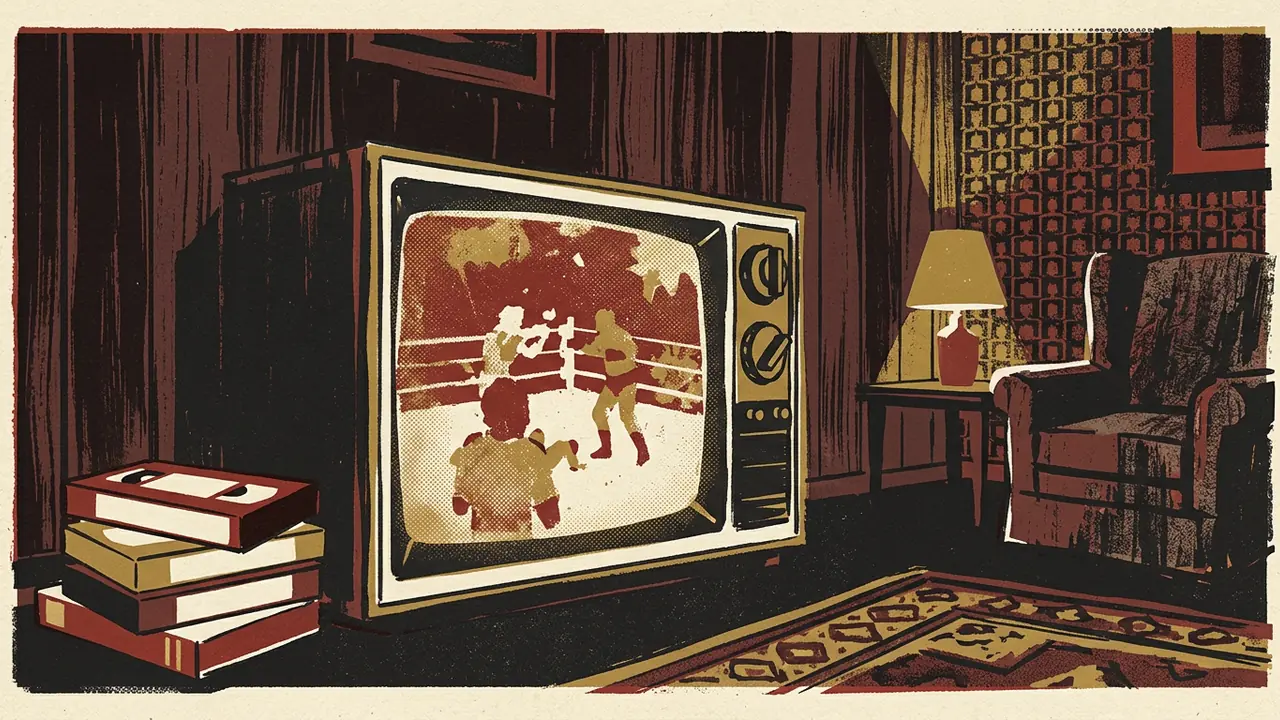
The 1980s wrestling boom turned a regional territory business into a national entertainment product in less than a decade. Between Vince McMahon's 1982 purchase of his father's promotion and the steroid trial that closed the books on the era in 1994, wrestling rebuilt itself around cable television, pay-per-view, pop music, and toys. The in-ring work was often the least important part of the package. That was the point.
The look of the boom
Wrestling had been a television product since the 1940s, but the 1980s version looked like nothing that came before it. Neon ring skirts, spandex in colors chosen for how they read on videotape, and arena lighting built for cameras rather than the cheap seats. The WWF borrowed its production vocabulary from rock touring, and it was not subtle about it.
Entrance music was the clearest break with the past. A 1970s challenger walked to the ring in silence; by the middle of the decade a wrestler arrived with a theme, a signature walk, and a cue the crowd could chant back. Hulk Hogan used Survivor's "Eye of the Tiger" before Rick Derringer's "Real American" gave him the version most fans remember.
The performers who carried it
The style needed performers who fit it. Hogan, Roddy Piper, Andre the Giant, Randy Savage, the Ultimate Warrior, Junkyard Dog, Sgt. Slaughter, and the Iron Sheik were character actors as much as athletes, and the company booked them accordingly. The NWA offered the counterargument: Ric Flair, Dusty Rhodes, and the Road Warriors worked a harder, more physical style for audiences who wanted the opposite of the WWF's cartoon. Both approaches drew money.
The spectacle scaled up fast. WrestleMania I filled Madison Square Garden and closed-circuit theaters in 1985; WrestleMania III ran the Pontiac Silverdome in 1987 with an announced attendance of 93,173. The Slammy Awards, an actual awards show with statuettes, aired on MTV in 1986 and 1987. Wrestling had decided it was a variety business.
MTV and the music-video crossover
The crossover started almost by accident. Cyndi Lauper cast manager Lou Albano as her father in the "Girls Just Want to Have Fun" video in 1983, and the WWF turned the association into an angle. Albano became a television character again, Roddy Piper insulted Lauper on "Piper's Pit," and the feud put the company on MTV at the moment the channel needed loud, cheap programming.
"The War to Settle the Score" aired on MTV in February 1985, with Hogan defending the title against Piper and Mr. T at ringside. Six weeks later came WrestleMania I. "The Wrestling Album" followed on Epic Records, produced by Derringer, with a group cover of "Land of a Thousand Dances" and a video that played like a recruitment ad. The WWF called the whole thing the Rock 'n' Wrestling Connection, and the name stuck.
Saturday morning
"Hulk Hogan's Rock 'n' Wrestling" premiered on CBS in September 1985, produced by DIC Entertainment, and ran for two seasons. Saturday Night's Main Event had already returned the WWF to NBC network television that May. The cartoon and the network specials did the same job from opposite ends: they made the wrestlers familiar to people who would never buy a ticket.
The crossover had limits. Music television wanted novelty, and novelty has a short shelf life; by 1987 the WWF's pop presence was a fixture rather than a story. What survived was the format — the entrance, the video package, the celebrity in the front row — which every promotion would use afterward.
Merchandise becomes the margin
Before the boom, a promotion lived on the gate and local television. The WWF added licensing as a third revenue stream, and it changed the economics. T-shirts, caps, posters, bed sheets, and lunchboxes turned wrestlers into brands that could be sold in a department store to someone who had never attended a show.
The toy aisle as a second roster
LJN's Wrestling Superstars line arrived in 1984 and set the template. A wrestler who existed in plastic was, in practical terms, more valuable than one who only worked house shows, and the toy line quietly shaped which performers the company pushed. Ice cream bars and plush Wrestling Buddy dolls followed the same logic.
The consequence was a shift in how success was measured. A mid-card wrestler with a memorable look and a catchphrase could outsell a better worker with neither, and the booking followed the merchandise. Licensing helped pay for national television, and national television sold the licensing. The loop was the business model.
The undercard problem
National expansion required a national roster, and the WWF assembled one by signing talent away from the territories. The result was a top of the card that could sell a stadium and an undercard that often could not sell a house show. Television made it worse. Squash matches built stars efficiently, but they also trained audiences to expect one-sided matches and left the middle of the card without stories.
The consolidation was brutal. On July 14, 1984, the WWF took over Georgia Championship Wrestling's Saturday slot on TBS, a date fans still call Black Saturday. World Class Championship Wrestling in Dallas drew strongly in syndication around the Von Erichs before a run of personal tragedies gutted it. The AWA, Mid-South, and dozens of smaller offices either sold, shrank, or closed.
The NWA and its remaining members had deeper rosters and better matches, but less money and less reach. That imbalance defined the decade: the promotion with the best wrestling usually lost to the promotion with the best television, and the middle of every card got thinner as a result.
How the boom ended
The end came in stages. The first was legal. A 1991 federal case against Dr. George Zahorian, a physician who supplied steroids to wrestlers, led to McMahon's 1993 indictment on charges of distributing steroids to his performers. A jury acquitted him in July 1994, but the trial aired the industry's drug culture in public and pushed the WWF toward smaller performers.
The second was creative. The formula that worked in 1987 — the patriotic hero, the monster of the month, the celebrity cameo — felt tired by 1992. Attendance fell, the company's momentum stalled, and the WWF rebranded around a "New Generation" of Bret Hart, Shawn Michaels, and Diesel. It was a reset, not a boom.
The third was competition. Ted Turner's purchase of Jim Crockett Promotions in 1988 created World Championship Wrestling, and WCW signed Hogan in 1994. A business that had spent a decade with one dominant national player suddenly had two, and the next boom would be fought on Monday nights.
What the 1980s left behind was infrastructure: the pay-per-view calendar, the licensing operation, the entrance as a set piece, the idea that a wrestling company could also be a media company. The boom ended, but almost nothing about the business went back to the way it was.