The pay-per-view era and the big-event economy
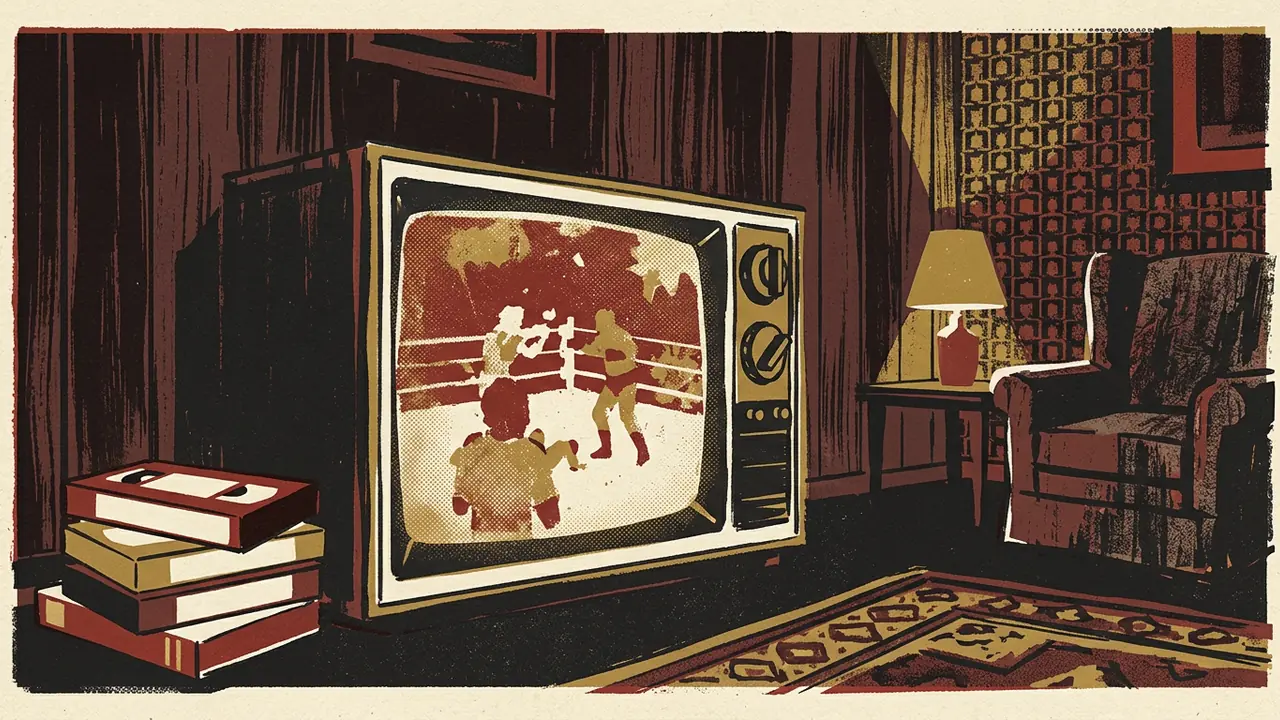
Pay-per-view was not a wrestling invention. It began as a way to sell a single night of television to people who could not get into the building, and wrestling spent roughly three decades turning that mechanism into the backbone of its business. The pay-per-view era explains a great deal about the modern product: why the calendar is shaped the way it is, why certain matches are built for months, and why the industry eventually traded the big-night gamble for a monthly subscription.
Closed circuit before cable
Before a cable system could authorize a single channel for a single household, the only way to sell a live event to a mass audience was to sell it to venues. Closed-circuit distribution sent the signal by satellite or dedicated line to arenas, movie theaters, and civic auditoriums that had paid for the feed and then sold tickets to fill their seats. The promoter collected a fee, the venue kept the gate, and the audience got a big fight on a screen with a crowd around it.
Boxing proved the model and wrestling borrowed it. A closed-circuit card meant contracting with hundreds of venues, which put real money at risk before the first ticket was scanned. It also meant the event had to be large enough to justify a night out. Regional wrestling rarely cleared that bar. A national promoter with a cable footprint and a marquee name could.
Renting an audience
The venue-by-venue approach had a side effect that promoters noticed. It made the event feel like an occasion rather than a private purchase, and that feeling was worth money. When cable pay-per-view arrived in the 1980s, the first major wrestling spectaculars were sold both ways at once, available in theaters and arenas where closed circuit still worked and on home television where the cable systems had been wired for it.
The monthly event model
Cable changed the arithmetic. Once a system could authorize one channel for one night and bill the subscriber directly, the venue middleman disappeared and the promoter could reach every wired home in the country. By the late 1980s the major promotions had settled into a rhythm: a pay-per-view card roughly every month, with the largest shows pinned to fixed points on the calendar.
The weekly television stopped being the product and became the advertisement. Storylines existed to make the next pay-per-view feel unmissable, and the free shows ended with a hard sell for the paid one. That inversion is the defining feature of the era, and it is still visible in how modern cards are built.
Tiering the calendar
Midway through the 1990s, WWE introduced a recurring series of shorter, lower-priced shows to fill the months between its established tentpoles. The move formalized a hierarchy that had been developing for years: a handful of major events, a longer run of secondary ones, and a weekly television product that fed both. Rival promotions ran variations on the same structure, and the industry as a whole came to treat the calendar itself as a product line.
Buy rates and card construction
Performance was measured in buy rate, the percentage of homes capable of ordering an event that actually did. That number drove everything. A strong buy rate justified a higher suggested price and a bigger production budget for the next show; a weak one could reset a promotion's plans for a year.
Because one night carried the whole month, card construction bent toward a single match. The undercard mattered for the live crowd and for keeping the arena hot, but the decision to buy was made on the main event. Promoters learned to stretch a program across weeks of television, using contract signings, ambushes, and the occasional pull-apart brawl to convert a feud into a purchase.
Where the money went
The retail price did not belong to the promoter. Cable operators and satellite providers took a distribution cut that in the early years commonly ran to roughly half of the suggested price, and sometimes more. A promotion selling a forty-dollar event might see something closer to twenty before production costs, which explains the persistent pressure to raise prices and to add dates. It also explains why the arrival of a self-owned streaming platform looked so attractive to the people signing the checks.
The piracy problem
Scrambled signals were never as secure as advertised. Descramblers circulated, satellite dishes pointed at the wrong feed, and closed-circuit transmissions leaked to anyone with the right receiver. Each generation of technology produced its own workaround, from modified set-top boxes to unauthorized streaming sites to the far simpler practice of splitting a password among friends.
The damage was less about stolen revenue than about pricing power. When a meaningful share of the audience can watch without paying, the promoter cannot push the price much higher, and the cable operator's cut becomes harder to justify. Piracy set a ceiling on the pay-per-view model long before streaming made the ceiling irrelevant.
The streaming replacement
In 2014 WWE launched its own subscription service, folding the entire pay-per-view calendar and the company's tape library into a single monthly fee that cost less than one event. The logic was partly defensive and partly structural: own the distribution, capture the subscriber directly, and stop handing a distribution cut to a cable operator for the privilege of reaching the audience.
Everyone else arrived at the same conclusion at different speeds. The UFC made its pay-per-views part of an ESPN+ bundle. AEW, which had sold its cards through a digital storefront, moved them onto the streaming platform of its broadcast partner. WWE's own library was folded into Peacock in the United States in 2021, while the standalone service continued in other markets.
What the flat fee changed
The monthly event survived as a format but stopped being a purchase decision. A subscriber who has already paid does not weigh each card the way a household weighing a fifty-dollar order once did, and the booking incentives shift accordingly. Long arcs and month-to-month retention matter more than a single hot main event, and the undercard gets room to build stories that pay off later.
The old model rewarded the spectacular and punished everything around it. The new one rewards consistency. Neither is neutral about what a wrestling show should be, and the difference between them is the clearest legacy of the pay-per-view era.