Where professional wrestling came from
The origins of professional wrestling are usually told as a story about fakery, which gets the sequence backward. For most of the nineteenth century, men wrestled each other for money in bouts that were genuinely contested and often brutal, and the fixing came later, for reasons that were mostly financial. The shift from the real match to the worked one explains a great deal about how the business still runs.
Carnival booths and challenge matches
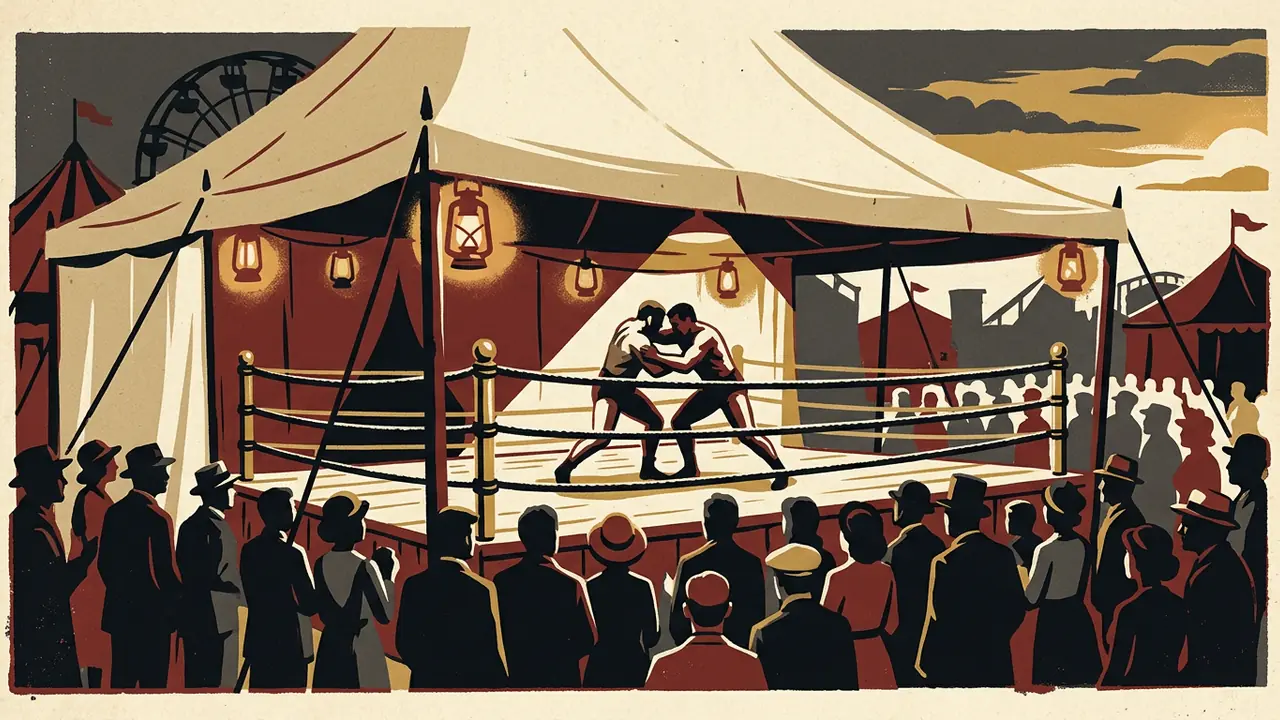
The first paying wrestling audiences in Britain and America met the sport at fairs, circuses, and traveling carnivals, where a showman built a platform, hired a resident wrestler, and posted a standing offer: any man in the crowd who could last a set time or throw the house man would take home a cash prize. The prize was real, and so, usually, was the wrestling. The house man was a trained professional, often a catch wrestler with a decade of hard matches behind him, and the local volunteer was almost always out of his depth.
The booth served several purposes at once. It sold tickets to a crowd that had come for something else, it advertised a wrestler to promoters who might book him at a proper venue, and it provided a place where a man could earn a few dollars between engagements.
The man who came out of the crowd
Not every challenger was a stranger. Showmen routinely salted the crowd with an employee, a plant who would climb up, make a show of reluctance, and then either get thrown convincingly or last long enough to prove the offer was on the level. The plant did the work a modern angle does: he warmed up the crowd, demonstrated that the challenge was genuine, and gave the house man a chance to look generous or ruthless depending on what the crowd wanted. It also let the booth test a real unknown before offering a serious match.
This is the first place the business learned the lesson it has never unlearned. The crowd is part of the show, and the crowd can be cast.
Catch-as-catch-can becomes a spectator sport
The style that carried wrestling out of the fairground and into the theater was Lancashire catch-as-catch-can, a rough, unglamorous form developed in the industrial towns of northwest England. The name describes the rule: catch hold of your opponent however you can, from a standing start, with no jacket to grip and no restriction on where you take the hold. It was a submission style as much as a pinning one, and its best practitioners were valued for the ability to hook a limb and end a match suddenly.
A style without a jacket
That mattered commercially. Catch wrestling was legible to a paying crowd in a way that Greco-Roman, an upper-body style fought in a jacket with a narrow range of holds, often was not; it looked like a fight and it could end in a moment. Emigrants carried it to the United States, where by the 1880s it had displaced the older styles and become the thing promoters meant when they advertised a wrestling match.
Wrestlers traveled circuits of music halls, opera houses, and athletic clubs, usually in mixed-style matches, and the championship was a claim rather than an award. No sanctioning body conferred it and none could take it away. A man declared himself world champion, defended the claim in print, and took on all comers, which is why there were often several champions at once, each with a different claim.
When the matches started being worked
A champion is a promoter's entire inventory, and a legitimate contest puts that inventory at risk every time it is exposed. One unlucky night, one injury, one unknown with a good night's work, and the draw is gone. That was the promoter's problem, and it could not be solved inside a real contest.
There were practical aggravations too. Genuinely contested matches between evenly matched men could run for hours or end without a decisive finish, and a crowd that had paid for a two-out-of-three-falls bout might go home with a draw and one working leg between them.
The arithmetic of the draw
Prearranging the finish solved all of it at once. If the outcome was known in advance, the promoter could promise a rematch before the first match had happened, protect a champion through a long program, and keep a popular but limited performer looking strong. He could guarantee the length of the show, the health of the talent, and the result. What he sold stopped being a contest and became a product with a reliable supply.
Historians place the change differently in different markets, but most accounts put the tipping point in the United States in the first two decades of the twentieth century, with the last genuinely open world title matches usually dated to somewhere around 1908 to 1911. By the 1920s the worked match was not an exception. It was the business.
The most influential of the early operators were the wrestler Ed "Strangler" Lewis, his manager Billy Sandow, and the promoter Toots Mondt, who between them controlled a large share of American talent in the 1920s. They are generally credited with turning the worked match into a system: time limits, a contracted roster, faster action, finishes arranged in advance. Their real innovation was less the fixed result than the scheduling.
The first stars and the first scandals
Wrestling's first genuine national celebrities were built on that ambiguity. Frank Gotch, an Iowa farm boy trained by the veteran catch wrestler Farmer Burns, became one of the most famous athletes in America in the years around 1910, and his matches with the Estonian strongman George Hackenschmidt drew enormous crowds. Gotch was a real wrestler in a real sport that was rapidly becoming something else.
As the worked share of the business grew, so did suspicion. Newspapers that had covered wrestling on the sports pages began to notice that champions rarely lost to anyone unexpected. In the early 1930s a promoter with a grievance, Jack Pfefer, gave a New York newspaperman a guided tour of how the business worked, and the articles that followed treated wrestling as a con rather than a sport.
State athletic commissions then had to decide what they were regulating. A few treated wrestling as a sport and licensed it; others concluded it was an exhibition and stepped back; promoters argued whichever way suited the license or the tax. The lasting effect was that wrestling lost the newspaper coverage that had made Gotch famous and built its own press instead, a pattern that held until television.
What the carnival era left behind
The shape of a modern card, a hero and a villain and a crowd that knows which is which, comes almost directly from the booth. The house man was the local hero's opposite, the traveling outsider, and the language of heels and faces carries that history in its bones.
The vocabulary of the con
So does the vocabulary. Mark comes from carnival slang for the target of a swindle, and wrestlers used it for the part of the audience that still believed. Work and shoot, rib, and the mid-century word kayfabe come from the same fairground patter, which fans adopted as an in-group language and kept alive long after the carnivals closed.
The promotional language survived too. "World champion," "scientific," "athletic," and "unbeaten" were all barker's words before they were sports-page words, and the title belt was a promotional device long before any body awarded one. The carnival did not disappear when the tents came down. It became the grammar of the business.