Championship belts: object, symbol and prop
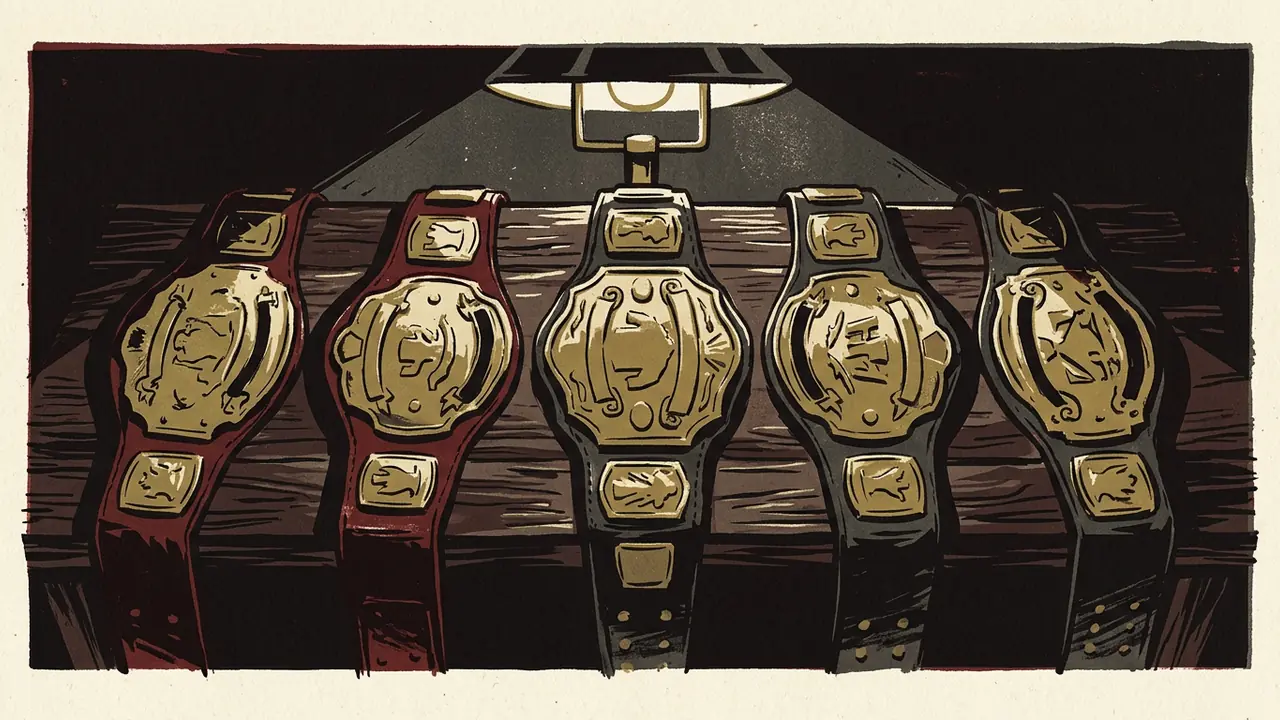
A championship belt is the only prop in wrestling the audience reads as valuable before anyone explains why. A wrestler can walk out with no music, no video, and no interview time, and the strap over the shoulder still tells you the character matters. That is a lot of narrative weight for an object that is, physically, a length of leather with metal bolted to it.
From trophy to wearable prop
Prize belts predate professional wrestling as a performance. Boxing, rowing, and amateur athletics all handed out ornate belts to champions in the late nineteenth and early twentieth centuries, often paid for by a newspaper, an athletic club, or a promoter rather than a governing body. Early wrestling champions inherited that convention directly. The belt was a presentation piece first and a piece of equipment second.
Wrestling kept the belt and quietly discarded the cup, and the reason is staging. A trophy lives on a table. It is photographed once, then stored. A belt lives on a body. It goes to the ring, the airport, the press event, and the bar afterward, and it is visible from the cheap seats in a way a silver cup never is.
The strap solves a staging problem
Once a promotion is selling tickets to a live crowd, the champion needs a silhouette that reads at distance. A belt worn across the shoulder or around the waist does that with no lighting, no camera, and no commentary. It also moves easily between people, which matters more than it sounds: a trophy has to be carried to the ring by a third party, while a belt can be unbuckled, handed over, and raised in a single gesture.
That portability is why the belt became a prop as well as a prize. It can be stolen, dropped, refused, worn by the wrong person, or swung at someone's head. None of those options are available with a cup.
Design language by era
The earliest wrestling belts were closer to jewelry than to modern sports merchandise, with elaborate silver or gold plates and little thought given to how they would look on camera. As the business moved from carnival and arena circuits into television, the design brief changed. Belts had to read in black and white, then in color, then in high definition.
Territory-era belts leaned heavily on emblems: eagles with spread wings, crests, shields, and regional motifs that told a local crowd whose title this was. The most famous example is the domed globe design associated with the National Wrestling Alliance, known among fans as "ten pounds of gold." Its main plate is a globe, and the shape has outlived nearly every promotion that defended it.
Eagles, globes, and the logo turn
The 1980s brought gold-dominant designs built around a single strong image, with the winged eagle belt of the World Wrestling Federation as the obvious reference point. Through the 1990s and 2000s, plates grew larger and more sculpted, and the main plate increasingly carried a promotion's corporate mark rather than a symbolic animal. Modern designs are effectively billboards: the logo is the largest element, and everything else is framing.
Side plates followed the same arc. Once a decorative afterthought, they became a place to record individual achievement, with names or dates added for specific champions. That is a small design decision with a large storytelling payoff, because it makes the belt look like a record rather than a costume piece.
Lineage and the recognition problem
A belt is a physical object. A championship is a claim. The two usually travel together, but not always, and the gap between them is where wrestling's messiest history lives.
Promotions write their own title histories, which means they also decide which switches count. A change that happened in a building nobody was filming may be recognized, ignored, or quietly reinterpreted decades later. Vacancies get filled by tournament, by award, or by assertion. When a company buys another company's library, it typically inherits the footage and the trademarks, and then has to decide what to do with the championships attached to them.
Two belts, one champion
Unification matches create the clearest version of the problem. Two champions meet, one wins, and the loser's title is either retired or revived later under new terms. Fans argue for years about whether the surviving championship carries the older lineage or merely borrowed its name. There is no neutral arbiter, because professional wrestling has never had one, and the promotions prefer it that way.
The result is that a title's history is a curated document. That does not make it fake; it makes it editorial. The belt in the ring is a prop with a paper trail behind it, and the paper trail is controlled by the people selling the tickets.
The replica market
For most of the twentieth century, a fan's only contact with a championship belt was from the far side of a guardrail. That changed as licensing matured and manufacturing moved offshore. Replicas now come in tiers, from inexpensive display pieces with printed plates to heavy leather-and-metal versions built to be worn.
The market splits roughly in two. Licensed replicas are sold as merchandise, often tied to a specific promotion's current design or a nostalgic reissue of a classic plate. Unlicensed makers fill the gaps, producing older designs that rights holders no longer sell, along with custom belts for independent promotions, gyms, and backyard shows.
What buyers are purchasing is not really leather and zinc alloy. It is the symbol, at a scale they can own. A replica belt on a wall functions as a piece of fandom the way a jersey does, except that the belt was never a piece of athletic equipment to begin with. It was always a representation of an achievement, which makes copying it philosophically simpler than copying a game-worn shirt.
What a belt does in a story
In narrative terms, the championship belt is a MacGuffin that can be worn. It gives a feud a physical object to fight over and a visual to cut to when the talking segments run long. When a referee holds it up before a match, the audience understands the stakes without a single line of exposition.
It also creates its own grammar. The belt shot, the tug-of-war over the strap, the champion who refuses to let go of it during a beatdown, the challenger who drapes it over a fallen rival's chest as an insult. These are conventions now, understood by anyone who has watched for a month, and they exist because the object is heavy, shiny, and easy to read.
That is the belt's real function. It converts an abstract claim into something an audience can see, carry, and argue about. The leather and the plates are just the delivery mechanism.