AEW and the modern competitive era
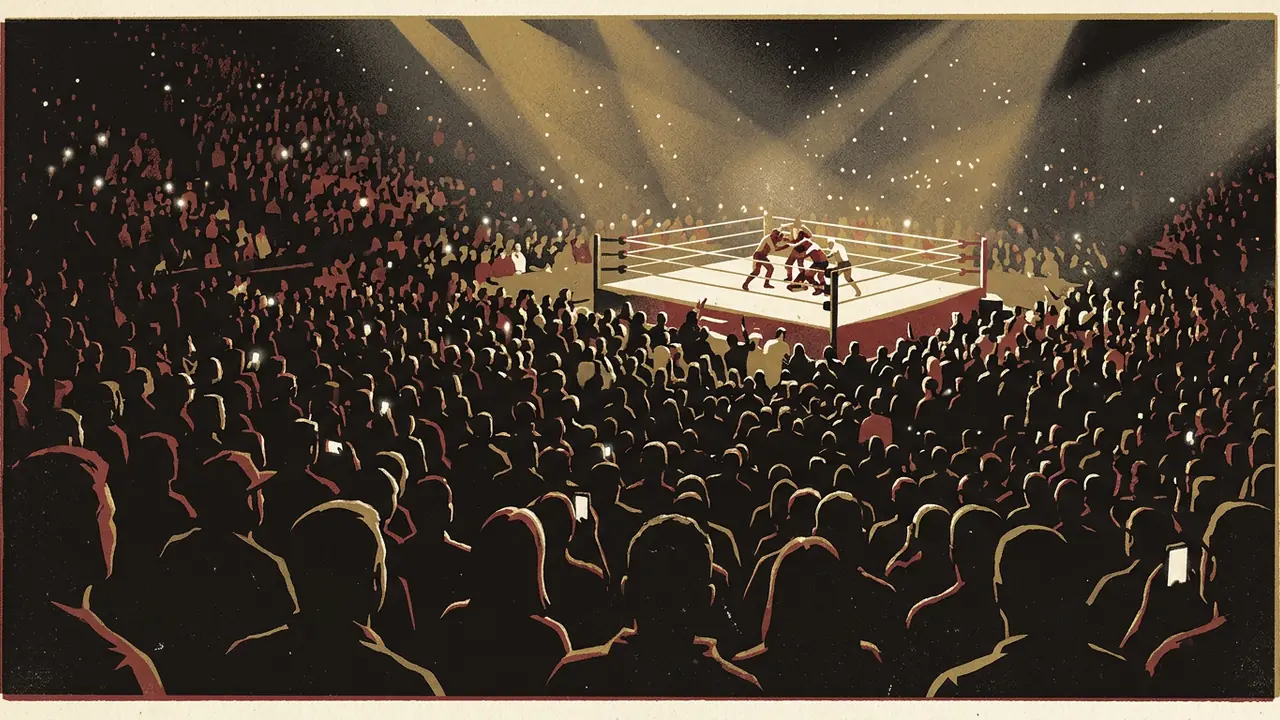
AEW's history does not begin with a wrestling company. It begins with a family fortune willing to underwrite one, a group of independent wrestlers who had already proven they could sell an arena without a national promotion behind them, and a television deal that would follow rather than lead. That order of operations explains most of what the company has done since.
The founding and the funding
All Elite Wrestling was announced in January 2019, with Tony Khan as president and Cody Rhodes, Kenny Omega, and the Young Bucks installed as executive vice presidents and in-ring talent. Khan, the son of Jacksonville Jaguars and Fulham owner Shahid Khan, supplied the capital. The Elite supplied the audience, the credibility, and the name recognition.
All In as the proof of concept
The venture's real starting point was All In, a self-financed independent show the Elite promoted in the Chicago suburbs in September 2018. It sold out, drew attention well beyond the usual independent wrestling press, and demonstrated that a wrestler-led project could draw a paying crowd on its own terms. AEW was effectively that experiment with a billionaire's balance sheet attached.
Money mattered less for the wrestling than for the infrastructure. A national promotion needs television production, arena holds, insurance, and the ability to sign performers to guaranteed deals before a single ticket has sold. The Khan backing let AEW start at that scale rather than climbing toward it, which is a luxury no American promotion since World Championship Wrestling had enjoyed.
The presentation difference
AEW launched as a workrate-first product. Matches ran longer than the WWE norm, the in-ring style leaned toward the independent and Japanese circuits its founders came from, and the promotion framed itself around athletic competition rather than character drama. Backstage skits were fewer. Promos were often live in the ring rather than pre-taped.
The company also committed to a live crowd every week, treating the audience in the building as part of the broadcast rather than a backdrop. That choice shaped the look of the show and the way angles landed. A hot crowd can carry a segment that would die in an empty studio, and AEW's early reputation was built on exactly those reactions.
Records, rankings, and the sports framing
Win-loss records and a rankings system were part of the original presentation, an attempt to borrow the logic of legitimate sport. The execution has been uneven across the years, but the intent was clear: give the audience a reason to care about results beyond the next pay-per-view, and give matches a stated stake.
Talent relations after the monopoly
For nearly two decades, WWE was the only major buyer of wrestling labor in North America. That changed the moment AEW could offer a contract. Performers who had grown frustrated with their position suddenly had somewhere to go, and the first wave of departures made the point. Jon Moxley left WWE and appeared for AEW in 2019; Bryan Danielson and Adam Cole arrived in 2021.
The traffic ran both ways. Cody Rhodes returned to WWE in 2022, a signal that the labor market had become genuinely two-way rather than a one-way exit from the industry leader. Free agency, in the sense that term carries in other sports, became a real feature of the business for the first time since 2001.
Working both sides of the line
AEW also allowed talent to appear for other promotions, most visibly New Japan Pro-Wrestling through the Forbidden Door events that began in 2022. That openness was a deliberate contrast with the exclusivity that had defined the previous era, and it made AEW a hub rather than a closed shop. It also created complications, since a performer working elsewhere is a performer not protected by the home promotion's booking.
The ratings conversation
Dynamite premiered on TNT in October 2019 and moved to TBS in 2022; Collision was added in 2023. From late 2019 into 2021, Dynamite ran head-to-head with WWE's NXT on Wednesday nights, and the weekly numbers became the primary public measure of the company's standing.
That head-to-head ended when NXT moved nights, but the discourse did not. Ratings dominate because they are the only competitive metric released on a reliable schedule, and because fans treat them as a scoreboard for an argument they are already having. Total viewership and the demographic numbers tell different stories, and partisans on both sides cite whichever figure favors their position.
The numbers matter commercially, but they measure a broadcast more than a promotion. A weekly show can lose viewers while a pay-per-view business grows, and a strong rating does not by itself indicate a healthy locker room or a coherent card.
What a second promotion restores
The most durable effect of AEW's arrival is leverage. A performer with two potential employers negotiates differently than one with a single option, and that applies to money, dates, creative input, and the willingness to walk away. Contracts lengthened and guarantees improved across the industry, not out of generosity but out of competition.
The 1990s war is the wrong comparison. That was two companies of comparable size on the same night, trading edgy content and raiding each other's rosters on roughly equal footing. AEW versus WWE is asymmetric: one company is a global media business, the other a challenger with a single major television partner. The contest is over talent and a slice of the audience, not over who owns Monday night.
What a second promotion restores, then, is not the spectacle of a war but the basic conditions of a labor market. Performers can be paid for their value rather than their seniority, and the audience gets an alternative to accept or reject on its merits. That is a smaller story than the Monday Night Wars, and a more consequential one for the people in the ring.