Catch-as-catch-can: the grappling style underneath the spectacle
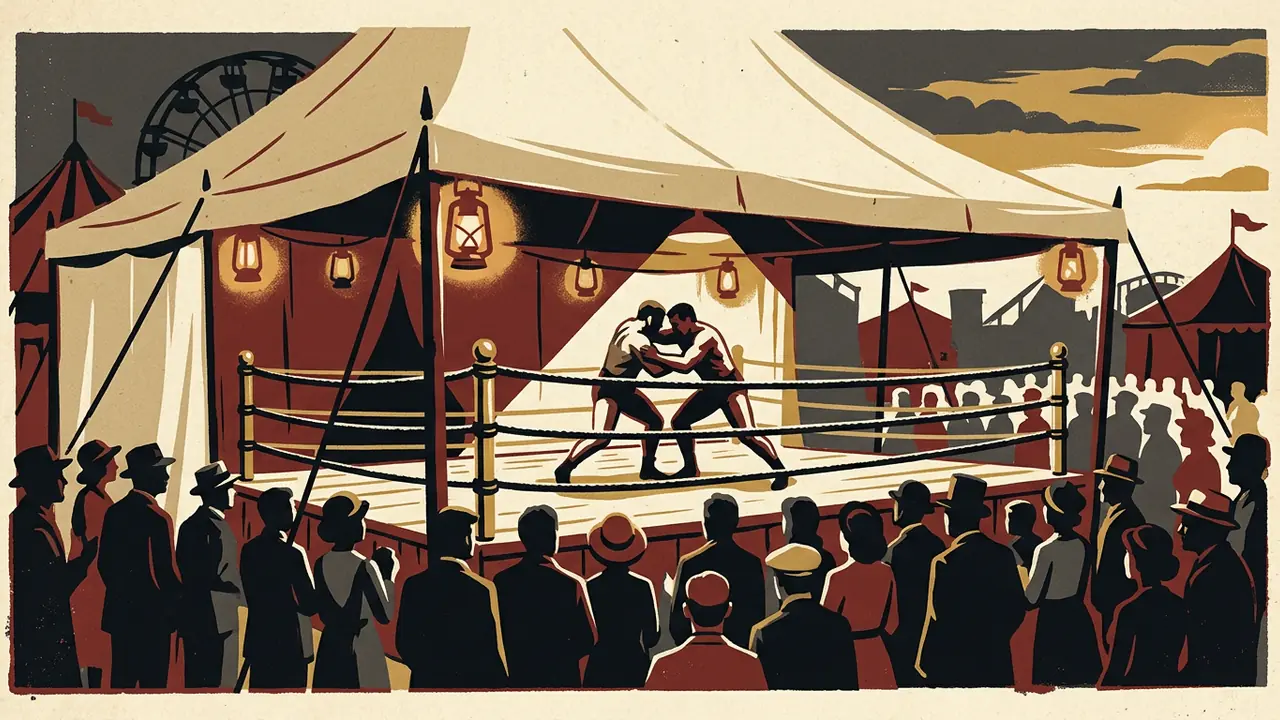
Catch as catch can wrestling is the legitimate sport that professional wrestling grew out of, and the name is older than the ring itself: it means by whatever means possible. Two men, no strikes, almost any hold permitted. What set it apart from other grappling styles was the size of that "almost" — how much a wrestler was allowed to do to a resisting opponent, and how much of the rulebook was built around hurting him.
What the rules actually were
Most catch matches were decided over falls, commonly best two out of three. A fall was awarded for pinning both shoulders to the mat for a count — three seconds under most American rulesets — or for forcing a submission, signaled by a verbal concession or a second throwing in the towel. A wrestler who reached the ropes, or who worked free back to a neutral standing position, earned a restart rather than a fall.
Striking was barred almost everywhere. No closed-fist punching, no gouging, no kicking. But holds were legal on any part of the body, legs included, which is the sharpest contrast with Greco-Roman wrestling and its ban on anything below the waist. Strangleholds were permitted under some rulesets and forbidden under others, and time limits, weight classes, and count lengths varied from commission to commission. There was no single universal code, only a family of local ones.
Hooking, and why the word mattered
A hold applied with real intent — sunk in, leveraged, aimed at a joint or an artery — was a hook. The verb was "hooking," and a man who could do it was a hooker. This was not a stylistic flourish. It was the difference between controlling an opponent and ending his night, and everyone in the building understood which of the two they were watching.
Lancashire to the American circuit
The style took recognizable shape in the cotton towns of Lancashire in the nineteenth century, where matches were wrestled for purse money at fairs, wakes, and in the back rooms of pubs. Neighboring regions had their own jacket styles and belt-and-hold traditions, but catch-as-catch-can traveled best because it needed nothing but two men and a patch of ground.
Immigration carried it. Lancashire mill workers, Irish collar-and-elbow men, and Cornish wrestlers all landed in the industrial Northeast and Midwest, and by the late nineteenth century the sport had moved from fairgrounds into athletic clubs. The New York Athletic Club and the Amateur Athletic Union codified it, and the army's physical training at West Point under Tom Jenkins gave it institutional respectability. The freestyle wrestling event at the 1904 St. Louis Olympics was contested largely under catch rules.
The professional peak came with Frank Gotch, whose wins over Georg Hackenschmidt in 1908 and 1911 drew enormous crowds and settled the question of who was the best heavyweight in the world. It also marked the point where the sport began to slide toward arrangement.
Fairs, clubs, and the carnival tent
Carnival wrestling was the other pipeline. A traveling show needed a man who could handle all comers, and the ones who could — Farmer Burns is the standard example — became both the sport's teachers and its bridge to the worked era. Burns's mail-order course taught holds to a generation of wrestlers who never competed in a legitimate match in their lives.
Hooking and the lost submission art
Catch wrestling's submission game was built on pain compliance rather than choke or choke-adjacent control. Toe holds, the double wristlock, the hammerlock, the various strangles: each was designed so that the opponent had to concede or absorb damage. That is a different logic from modern submission grappling, where position and control come first and the finish is often a byproduct.
Hooking cannot be learned cooperatively. A man has to feel a joint being taken past its comfortable range by someone who will not stop, and he has to do it repeatedly, before he can apply the same hold under pressure. Once matches were fixed, that incentive evaporated. Nobody was going to endure a toe hold in a match whose finish was already decided, and nobody was going to risk injuring a colleague he'd be working with next week.
Why the hooks faded
The men who kept the knowledge were called shooters, and promoters used them for two jobs: as enforcers when a wrestler needed reminding who booked the building, and as credible opponents for champions who wanted at least one match a year that looked real. The skill survived in a handful of gyms rather than in the business at large.
What survived into the worked era
Plenty. The throw families came straight out of legitimate grappling — the suplex, the hip toss, the various lifts — and so did the mat vocabulary of riding, breakdowns, and the referee's position. Submission holds carried over almost intact, even when their application became theater. The double wristlock reappeared in mixed martial arts as the Kimura. The stepover toehold, the Boston crab, the figure-four, and the hold still called the Gotch toe hold all trace back to the sport.
The vocabulary
| Term | Catch-era meaning | Where it lives now |
|---|---|---|
| Hook | A hold sunk in to force a concession or do damage | A wrestler who "has hooks" |
| Hooker | A man who could apply those holds for real | "Shooter," "legit" |
| Shoot | A genuine contest | Any unplanned moment |
| Stretch | To work a hold until the opponent conceded | "He got stretched" |
| Ride, breakdown | Controlling a man on the mat | Amateur and pro coaching alike |
Catch wrestling today
The lineage runs most clearly through Wigan, where Billy Riley's Snake Pit turned out Karl Gotch and Billy Robinson, among others. Gotch's years in Japan are widely credited with seeding the shoot-style movement — the UWF and its successors, Pancrase, RINGS — which in turn fed the submission-heavy professional wrestling of the 1990s and after.
Outside Japan, the revival has been small and gym-based. Catch wrestling groups affiliated with the Wigan tradition teach hooking to submission grapplers and to professional wrestlers who want their holds to look and feel real, and catch rulesets appear in some grappling competitions. Josh Barnett is the most visible modern exponent. It is not a mass movement, and it does not need to be. The holds work, and the men who teach them are still arguing about the same things the Lancashire wrestlers argued about: what counts as a fall, what counts as an escape, and how far a hook is allowed to go.