The Gold Dust Triplets and the invention of the modern match
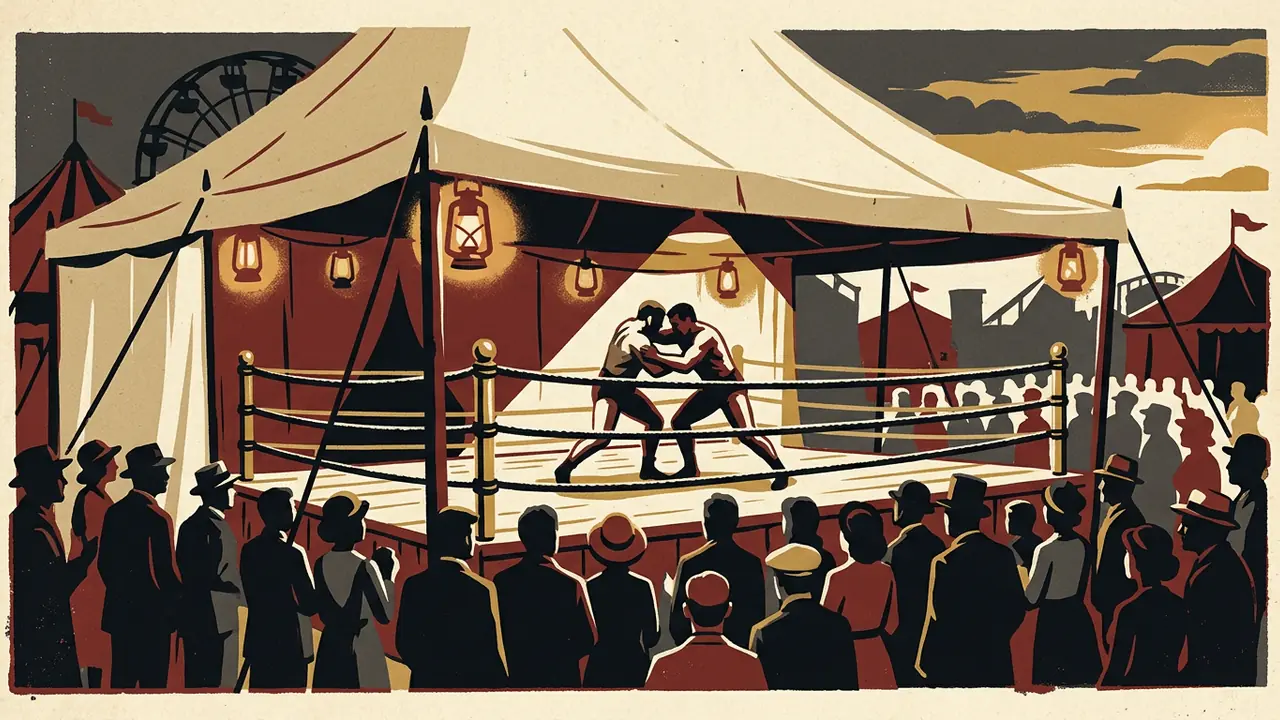
Long before television rights, pay-per-view, or a developmental system, three men working the arenas and carnival circuit of the American Midwest worked out most of what a modern wrestling match still is. Ed "Strangler" Lewis, his manager Billy Sandow, and the former wrestler turned booker Joseph "Toots" Mondt were known in their day as the Gold Dust Triplets, a nickname reportedly borrowed from a soap advertisement of the era. Their contribution was not a hold or a style but a business model: matches with a clock, finishes chosen in advance, and a champion who traveled instead of staying home.
Who the trio were
Lewis was the worker. Born Robert Friedrich in Wisconsin, he built a reputation as a legitimate catch-as-catch-can wrestler, the kind of man who could genuinely hurt an opponent and was known to do it when the money or the argument justified it. That credibility was the product. It allowed the Triplets to sell a bout as a real contest while privately deciding how it would end.
Sandow handled the money, the bookings, and the negotiations. He was the one who understood that a champion is not simply the best wrestler but an asset with a schedule, a price, and a lifespan, and that protecting the asset was a full-time job. Lewis without Sandow was a tough man on a mat. Lewis with Sandow was a title.
The man with the notebook
Mondt supplied the ideas. A wrestler of modest reputation and considerable imagination, he is the one most often credited with the shift from long, grinding mat exchanges toward what contemporaries called slambang wrestling — a blend of legitimate technique, brawling, and showmanship paced for a paying crowd. Where Lewis could win a fight and Sandow could sell one, Mondt could structure one.
The problem with a two-second finish
Wrestling before the Triplets was frequently a single fall, and a legitimate single fall can end in seconds. A man gets caught in a hold, cannot escape, and the evening is over before the crowd has settled into its seats. Promoters had sold a contest. The audience had paid for a contest. What they got was a moment.
The deeper problem was commercial. If the match is real, the best wrestler wins, and the best wrestler is not always the best draw. A champion who is genuinely unbeatable is a champion nobody can beat, which means every challenger is dead on arrival and every town has already seen the finish. The honest contest and the profitable one pulled in opposite directions, and no amount of tough talk resolved it.
Inventing the time-limit draw and the comeback
The Triplets resolved it by changing the shape of the match rather than the honesty of it. A time limit — sixty minutes, ninety for a title bout — turned a fight into a scheduled event with a beginning, a middle, and a guaranteed end. Two-out-of-three falls gave the audience more than one climax. The clock became a character.
The time limit also produced the draw, which turned out to be the most useful result in the business. A champion who cannot be beaten inside the limit keeps the belt and still looks strong. A challenger who takes the champion to a draw looks like the next champion without needing to win. Both men leave with something, the town gets a reason to bring the show back, and nobody has to pretend the lesser man was better.
Shine, heat, comeback
Within that frame Mondt built sequences that survive almost unchanged. One man dominates early to establish his skill. The other takes punishment in the middle while the crowd waits. Then the reversal: a burst of offense, a near fall, a second burst, a finish. Wrestlers later gave these phases names — the shine, the heat, the comeback — but the logic was already there in the 1910s. It is a structure, not a style, and structures are portable.
The travelling champion model
Before the Triplets, champions tended to stay close to the cities where their backing was strongest. The trio put Lewis on trains. He defended in dozens of towns against local favorites, most of whom the crowd genuinely believed could win, because the crowd had seen those men beat everyone else.
The local hero almost never took the title. He was protected instead — a count-out, a disqualification, a draw, an injury, a controversial decision — so that the town kept its hero's credibility and the promoter kept a rematch to sell. One belt, many towns. The champion became a touring property rather than a hometown man, and the title itself became the thing every territory wanted on its posters, because the title was the only asset that could be lent out and still belong to its owner.
Why this is the real founding moment
It is tempting to treat the Triplets as a stylistic footnote, a bridge between the shooters and the television era. That undersells them. Their insight was that wrestling's unit of sale is a story rather than a contest, and that story has a shape: stakes, a clock, a reversal, a resolution that sends the crowd home wanting the next chapter.
Almost every mechanism fans now take for granted descends from that decision. Weekly television with an angle running across weeks is the travelling-champion model with a broadcast schedule. A champion who rarely loses clean is a booking choice the Triplets made first. The protected finish, the rematch clause in spirit if not in contract, the sense that a belt is a character in its own right — all of it follows from the same premise.
Lewis, Sandow, and Mondt did not invent athletic wrestling, and they would likely have rejected the suggestion that they invented anything at all. What they built was a chassis. The territories, the cable boom, and the modern weekly show have all been bodies dropped onto it, and it has held.